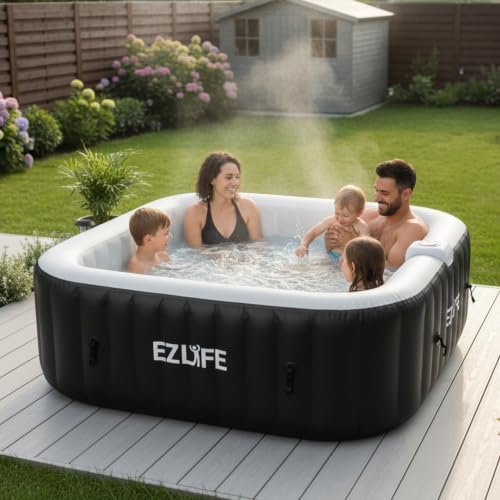
Running the Ezlife 6-Person Inflatable Hot Tub costs roughly $1.50–$3.00 per session under typical conditions — less than a cup of coffee from a sit-down café. But the exact number depends on how you use it, and it's worth knowing before you buy.
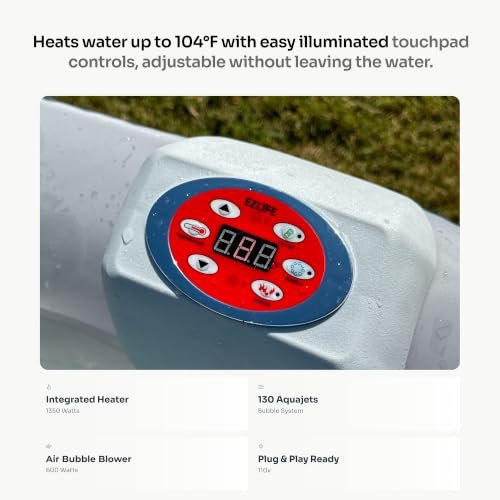
The two electrical components that draw meaningful power are the 1,350W heater and the 600W air bubble blower. The filter pump (12V/30W) uses so little electricity it barely registers. Here's how the math works out.
How the Wattages Add Up
Watt-hours = watts × hours. To convert to kilowatt-hours (what your utility bill charges for), divide by 1,000. The US average residential rate sits around $0.16/kWh as of 2024, per the U.S. Energy Information Administration — that's the figure used in all examples below.
The heater and blower don't run simultaneously at full draw all the time. The heater cycles on and off to maintain temperature once the target is reached. The blower runs only when you're actively in the tub with the jets on.
Per-Session Cost Estimate
| Scenario |
Heater (maintenance mode, ~50% cycle) |
Blower (jets on, full draw) |
Session duration |
Estimated cost |
| Short soak, mild weather |
0.675 kWh |
0.300 kWh |
1 hour |
~$0.16 |
| Standard soak, mild weather |
1.350 kWh |
0.600 kWh |
2 hours |
~$0.31 |
| Evening session, cool weather (heater working harder, ~80% cycle) |
2.160 kWh |
0.600 kWh |
2 hours |
~$0.44 |
| Cold weather, full reheat from 90°F back to 100°F before session |
~4.000 kWh |
0.600 kWh |
3 hours total |
~$0.74 |
Those per-session numbers look low — and they are, for active use. The real cost is standby heating: keeping 252 gallons at 100°F around the clock between sessions.
The Standby Heating Reality
If you leave the heater running 24/7 to keep the water hot and ready, the math changes significantly. In mild weather, the heater cycles at roughly 30–50% duty to maintain temperature — that's about 10–16 kWh per day, or $1.60–$2.56 daily just to hold temperature. Over a month, that's $48–$77 before a single soak.
In colder weather (below 50°F ambient), the heater works harder. Expect 60–80% duty cycles, pushing daily standby cost toward $3.50–$4.60 — roughly $105–$138 per month.
The smarter approach most regular users land on: use the timer or heating schedule to pre-heat 4–6 hours before a planned session rather than keeping the water hot continuously. You spend more electricity per heat-up event, but far less overall.
Monthly Cost Scenarios
| Usage pattern |
Strategy |
Estimated monthly cost |
| 2 sessions/week, warm weather |
Pre-heat before each session, cover on between |
~$15–$25 |
| 2 sessions/week, cool weather |
Pre-heat before each session, cover on between |
~$25–$45 |
| Daily use, mild weather |
Continuous standby heating |
~$50–$80 |
| Daily use, cold weather (below 50°F) |
Continuous standby heating |
~$100–$140 |
These are estimates based on stated wattages and US average electricity rates. Your actual cost depends on your local rate, ambient temperature, how well you use the insulated cover, and how often you open it. But the order of magnitude is reliable — and it's considerably less than most first-time buyers expect.
The insulated cover isn't optional if you care about running costs. Every hour the tub sits uncovered between sessions is heat escaping that the heater has to replace. Put the cover back on. It's the single cheapest efficiency improvement available.